
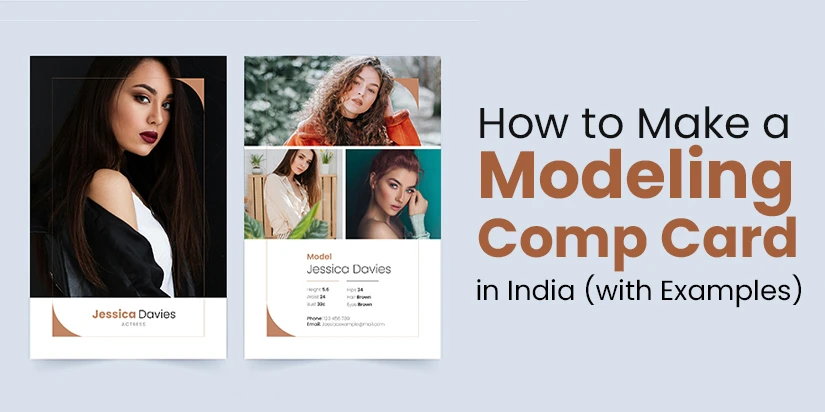
A good modeling profile should answer the basic questions a casting professional has before they decide to contact you. What do you look like? How tall are you? What are your measurements? Where are you based? How can you be contacted?
A modeling comp card in India can bring these details together in one simple document. It combines selected photographs with basic model information, making it easier for agencies, casting teams, and clients to understand your profile quickly.
You may also hear people use the term model zed card for a similar type of model presentation card. The terminology can vary between markets and agencies, so it is important to follow the format requested by the person or organisation you are contacting.
This guide explains what a comp card should contain, why it matters, how it differs from a portfolio, and how Indian models can prepare one for different types of modeling work.
Table of Contents
- What Is a Modeling Comp Card?
- Why Does a Modeling Comp Card Matter?
- What Should a Modeling Comp Card Include?
- How to Make a Modeling Comp Card in India
- What Should You Not Put on a Modeling Comp Card?
- How Should You Send a Comp Card to an Agency?
- Do All Modeling Agencies in India Use the Same Comp Card Format?
- When Should You Update Your Comp Card?
- FAQs
- Conclusion
What Is a Modeling Comp Card?
A modeling comp card, short for composite card, is a concise professional profile that presents a model’s photographs and key details in one place.
A modeling comp card in India can include:
- Model’s professional name.
- Main headshot.
- Selected additional photographs.
- Height.
- Bust or chest.
- Waist.
- Hips, where relevant.
- Shoe size.
- Hair colour.
- Eye colour.
- City or base location.
- Agency or professional contact details.
The purpose is not to show every photograph you have ever taken. Instead, it gives a casting professional a quick reference before they decide whether to look at your complete portfolio or request additional material.
The term model zed card is also used in some parts of the modeling industry. Other markets may use terms such as composite card or sedcard. Since terminology is not completely uniform, models should pay attention to the wording used in a particular casting or agency submission.
Why Does a Modeling Comp Card Matter?
A portfolio can contain many photographs, but a casting professional may not have time to review all of them at the first stage. A comp card provides a shorter introduction.
A well-prepared modeling comp card in India can be useful because it includes your name, photographs, measurements, and location, all the information can be viewed together. This makes it easier for someone to understand your basic profile without searching through separate messages or files.
1. Helps With Casting Requirements
Measurements can be important for assignments involving clothing, fittings, e-commerce, runway work, or other specific requirements. Accurate height, measurements, and shoe size give clients practical information before a fitting or casting.
2. Presents Your Images Selectively
Instead of sending a large collection of photographs, you can choose a few images that represent your current appearance and the type of work you want.
3. Keeps Your Professional Information Organised
A single document is easier to save and share than a collection of unrelated photographs and messages.
4. Works Alongside Your Portfolio
A comp card does not replace your portfolio. It gives a quick overview, while your portfolio provides a broader view of your work.
For an Indian model working across fashion, commercial, beauty, or e-commerce assignments, this distinction can make the submission process easier to manage.
What Should a Modeling Comp Card Include?
The exact requirements can vary, but most cards focus on photographs, measurements, and contact information.
| Element | What to Include |
|---|---|
| Name | Your professional or modeling name |
| Main image | Recent and clear headshot |
| Additional images | Selected photographs showing range |
| Height | Current height |
| Measurements | Relevant body measurements |
| Shoe size | Current shoe size |
| Hair colour | Current hair colour |
| Eye colour | Current eye colour |
| Location | City where you are based |
| Contact | Agency or professional contact information |
The most important rule is to keep this information accurate. Do not copy measurements from an old profile simply because they look better. Agencies and clients may use these details for casting, clothing selection, or fittings.
A model zed card should therefore represent your current profile rather than an older version of it.
Which Measurements Should Indian Models Include?
There is no single measurement list that every modeling agency in India uses. Requirements can change according to the agency, client, and type of modeling assignment.
Common information includes:
For Female Models
- Height.
- Bust.
- Waist.
- Hips.
- Shoe size.
- Clothing or dress size, when requested.
For Male Models
- Height.
- Chest.
- Waist.
- Inseam, when requested.
- Shoe size.
- Shirt, collar, or suit size where relevant.
Some assignments may request additional measurements.
How to Take Your Measurements Accurately
Use a soft measuring tape and stand naturally. The tape should remain level and comfortably against the body rather than being pulled tightly. Measure over fitted clothing or light clothing, and record the result carefully.
For height, measure without shoes. If possible, take your measurements more than once to check that the numbers are consistent. Current measurement guidance also recommends avoiding guessed or outdated numbers because accurate information is more useful for agencies and fittings.
How Many Photos Should Be on a Comp Card?
There is no universal number that applies to every agency. Many industry guides describe a small selection of around three to five photographs rather than a complete portfolio.
A useful selection can include:
- A strong headshot.
- A full-length photograph.
- A three-quarter or profile image.
- A fashion or editorial photograph.
- A commercial or lifestyle image, where relevant.
The important point is not simply the number of photographs. Each image should add something different.
For example, five photographs showing almost the same pose and outfit do not provide much more information than one photograph. A better selection can show your face, proportions, expressions, and range of work.
How to Choose Photos for Your Comp Card
Your photographs should represent how you look now. This is especially important if you have changed your hairstyle, hair colour, or overall appearance since your older photographs were taken.
1. Choose a Recent Main Photograph
Your main image should make your face easy to see. Avoid photographs where sunglasses, dramatic filters, or excessive editing hide your features.
2. Include Different Types of Images
The selection should depend on your modeling category.
- Fashion Modeling: Editorial, runway, and full-length fashion images can be useful.
- E-commerce Modeling: Clear photographs that show clothing, proportions, and different poses can be more relevant.
- Commercial Modeling: Lifestyle photographs with natural expressions may help show your commercial range.
- Beauty Modeling: Close-up images can be useful when facial features are central to the assignment.
The goal is not to make the card look dramatic. It is to help someone understand what kind of modeling work you can present.
What Should a Modeling Comp Card Look Like?
A clean layout is usually easier to use than a crowded design.
Front Side
The front can focus on:
- Your name.
- One strong headshot.
- Key statistics.
- Agency or contact details.
Back Side
The back can contain:
- Additional selected photographs.
- Remaining measurements.
- Relevant contact or agency information.
A traditional printed comp card commonly uses a front image and a reverse side containing additional images, statistics, and contact information. Digital versions can use the same basic structure in a single PDF or digital layout.
When preparing a modeling comp card in India, keep the text readable. Your photographs should remain the main visual element rather than competing with large graphics, decorative fonts, or unnecessary information.
Modeling Comp Card Example
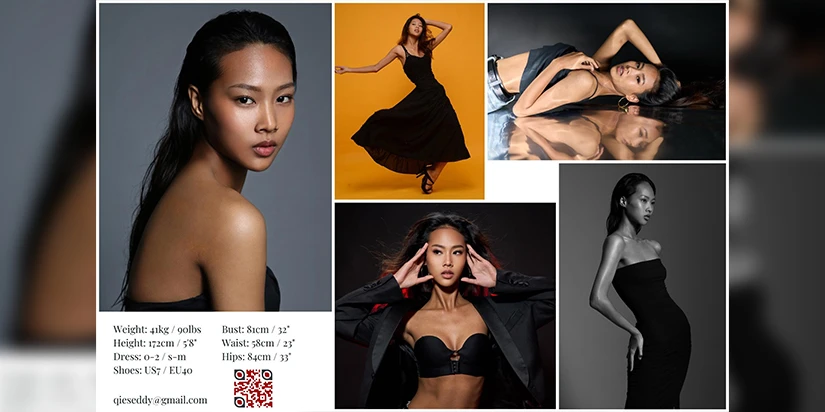
Image Source: www.reddit.com
Here is a simple fictional example of how a card could be structured.
RIYA SHARMA
Mumbai, India
Height: 175 cm
Bust: 82 cm
Waist: 61 cm
Hips: 88 cm
Shoe: UK 6
Hair: Black
Eyes: Brown
Photographs:
- Headshot
- Full-length photograph
- Editorial image
- Commercial image
Contact: Professional email or agency details.
This example is not a fixed template. A real card should be adjusted according to the model’s category and the requirements of the agency or client.
For example, an e-commerce model may give more space to clothing-focused photographs, while a fashion model may use more editorial or runway images.
Comp Card vs Portfolio vs Digitals
These three are often confused, but they serve different purposes.
| Comp Card | Portfolio | Digitals | |
|---|---|---|---|
| Main purpose | Quick model profile | Show wider range of work | Show current natural appearance |
| Photos | Selected images | Larger collection | Simple, minimally edited images |
| Measurements | Usually included | May be included | Often submitted separately |
| Design | Polished presentation | Portfolio-style presentation | Plain and natural |
| Use | Quick reference and casting | Detailed evaluation | Agency or casting assessment |
A model zed card is therefore not simply another name for a portfolio. It is a more concise presentation of your profile.
Digitals are different again. Agencies can ask for simple, current photographs to see your natural appearance. Some agencies may request digitals at the initial submission stage rather than a finished comp card.
Always follow the specific submission instructions you receive.
How to Make a Modeling Comp Card in India
Once your photographs and measurements are ready, creating the card becomes much easier.
Step 1: Collect Recent Photographs
Start with your current headshot and a few strong portfolio images.
Step 2: Check Your Measurements
Measure yourself again instead of relying on an old profile.
Step 3: Choose the Most Relevant Images
Select photographs according to the type of modeling work you want to pursue.
Step 4: Add Your Basic Information
Include your name, measurements, shoe size, hair and eye colour, location, and appropriate contact details.
Step 5: Keep the Layout Simple
Use clear headings, readable text, and enough space between different sections.
Step 6: Create a Digital File
A PDF is practical for online submissions because the layout remains consistent across devices.
Step 7: Check the Final Version
Open the file on your phone and computer. Check the photographs, spelling, measurements, contact details, and file name before sending it.
If an agency has provided its own template or requested a particular format, use those instructions instead of relying on a general template.
What Should You Not Put on a Modeling Comp Card?
A comp card should provide useful professional information without becoming a personal profile.
Avoid adding:
- Home address.
- Unnecessary personal information.
- Long biographies.
- Fake modeling experience.
- Incorrect measurements.
- Outdated photographs.
- Excessive filters.
- Too many photographs.
- Random social media accounts.
- Irrelevant qualifications.
You should also avoid making claims that you cannot support. A clean and honest profile is more useful than a card filled with unnecessary information.
How Should You Send a Comp Card to an Agency?
Creating a modeling comp card in India is only one part of the process. Before sending it, check what the agency or casting team has actually requested.
They may ask for:
- A comp card.
- Digitals.
- Portfolio photographs.
- A portfolio link.
- Measurements.
- An application form.
- A specific file format.
If they request digitals, do not replace them with heavily edited portfolio photographs. If they ask for a comp card, send the requested file rather than a large folder containing unrelated images.
Use a professional file name, such as: Riya_Sharma_Comp_Card.pdf
Also be cautious about sharing personal documents or sensitive information with unknown contacts. Verify the agency or casting opportunity before sending anything beyond what is reasonably required.
Do All Modeling Agencies in India Use the Same Comp Card Format?
No. There is no single format that every Indian modeling agency or client follows. The required information can vary depending on:
- Modeling category.
- Agency.
- Client.
- Casting.
- Location.
- Type of assignment.
- Digital or printed submission.
This is why copying another model’s card exactly may not be the right approach.
Instead, prepare a clean master version with your current information and adjust it when a legitimate agency or client provides specific requirements.
The same applies to the model zed card terminology. Some people use it interchangeably with a comp card, while others may use different terms depending on the market.
When Should You Update Your Comp Card?
Your card should represent your current appearance and information. Consider updating it when:
- Your measurements change.
- Your hairstyle changes significantly.
- Your hair colour changes.
- Your contact details change.
- You move to another city.
- You join or leave an agency.
- You have stronger photographs.
- You begin targeting a different modeling category.
There is no need to replace a card simply because a certain amount of time has passed if all the information and images are still accurate. What matters is keeping the information current and relevant.
7 Things to Check Before Sending Your Comp Card
Use this quick checklist before submitting your card:
- Recent photographs: Do the images represent your current appearance?
- Accurate measurements: Have you checked the numbers recently?
- Relevant images: Do the photographs match the type of work you want?
- Clear layout: Can someone find your key details quickly?
- Professional contact: Is the correct agency or professional contact listed?
- Correct file: Does the PDF open properly?
- Submission rules: Have you followed the agency or casting instructions?
These checks can prevent simple mistakes from making your modeling comp card india outdated or difficult to use.
Conclusion
A useful model zed card does not need complicated graphics or a long biography. It needs to make your professional profile easy to understand.
Before sending it, make sure your photographs are current, your measurements are accurate, your contact details are correct, and the images match the type of modeling work you want.
Most importantly, remember that a modeling comp card in India is only one part of your modeling profile. Your portfolio, digitals, experience, and professional communication all play different roles. When these materials are accurate and used for the right purpose, they give agencies and clients a clearer picture of what you can offer.
FAQs
1. What is a modeling comp card in India?
A modeling comp card in India is a concise professional profile containing selected photographs, measurements, and relevant contact or agency information. It gives casting professionals a quick overview of a model.
2. Is a model Z card the same as a comp card?
The terms can refer to a similar type of model presentation card. However, terminology varies across modeling markets and agencies, so it is better to follow the terminology and format used in the specific submission.
3. What information should be on a model comp card?
A typical card can include your professional name, photographs, height, relevant measurements, shoe size, hair and eye colour, location, and agency or professional contact information.
4. How many photos should a comp card have?
There is no universal number. Many industry guides recommend a small selection rather than a full portfolio, often around three to five additional or total selected photographs depending on the layout.
5. What measurements should a model include?
Common measurements include height, bust or chest, waist, hips, and shoe size. Additional sizing information can be requested for specific assignments.
6. Can a beginner make a comp card?
Yes. A beginner can prepare a simple card using recent photographs, accurate measurements, location, and professional contact information. There is no reason to add experience that you do not have.
7. Is a comp card the same as a portfolio?
No. A portfolio contains a broader collection of a model’s work. A comp card is a shorter profile designed to provide key information and selected images quickly.
8. Do agencies need a comp card or digitals?
It depends on the agency and stage of the submission. Some agencies request digitals when evaluating new applicants, while comp cards may be used for castings or professional bookings. Always follow the instructions provided by the agency.
9. What format should I send my comp card in?
A digital PDF is a practical option for online submissions, but the required format can vary. If the agency or client specifies a file type or template, follow those instructions.
Similar Posts