

Ashalata Ganpat Bhosale (born September 8, 1933) was raised in a musical home in Sangli, Maharashtra. After the early death of her father, Pandit Deenanath Mangeshkar, the family moved to Mumbai, where music became their means of survival. Asha began her playback career in 1943, initially taking “leftover” cabaret or side-character songs while her sister, Lata Mangeshkar, sang lead roles.
Instead of staying in the shadows, Asha reinvented herself. By collaborating with legends like O.P. Nayyar and R.D. Burman, she mastered everything from soulful ghazals to pop and rock, earning the title “Queen of Versatility.” Her career spanned eight decades, resulting in a Guinness World Record for the most recorded artist, with over 12,000 songs in 20+ languages.
Her honors include two National Awards, the Dadasaheb Phalke Award, and the Padma Vibhushan. Beyond the studio, she became a successful global restaurateur. Asha Bhosle passed away on April 12, 2026, at age 92. She leaves behind a historic legacy of resilience, proving that a difficult start can lead to a world-record-breaking journey.
Early Life Struggles: From the Shadows to the Spotlight
Asha Bhosle’s career didn’t start with instant fame; it started with hard work and a refusal to give up. Here is how she transformed from a newcomer into a legend:
- A Tough Start (1940s): When she entered the industry, lead roles and big songs were hard to get. She was often given “leftover” songs for smaller roles or “side” characters.
- The Learning Phase: Instead of quitting, she used every small opportunity to practice. She treated every recording as a lesson, slowly building her strength and finding her unique sound.
- The Big Turn: Her patience paid off. Top music directors began to notice that she could sing anything. She didn’t just sing; she adapted to every style.
- Legendary Partnerships: She teamed up with masters like O.P. Nayyar, R.D. Burman, and Khayyam. Each composer pushed her to try something new—from jazzy beats to soulful classical melodies.
The Result: What began as a struggle for survival turned into a 80-year legacy. Her journey proves that persistence and passion can turn a difficult start into a world-record-breaking career.
Career and Growth: Three Eras of Excellence
View this post on Instagram
Asha’s career was defined by her ability to adapt to the wildly different musical visions of India’s greatest composers.
The O.P. Nayyar Era: Where Rhythm Met Its Spark!
In the 1950s, O.P. Nayyar found in her a voice that perfectly matched his rhythmic imagination.
Their collaboration moved away from conventional melodic softness and leaned into swing, rhythm, and Western orchestration.
Songs such as “Aaiye Meherban” and music from Naya Daur (1957) revealed a singer capable of effortless charm, precise control, and expressive lightness.
The R.D. Burman Era: Redefining the Language of Music
The 1970s marked a turning point with R.D. Burman. This partnership reshaped the soundscape of Hindi cinema. Jazz, rock, funk, and Latin influences entered mainstream Bollywood with striking confidence.
“Dum Maro Dum” from Hare Rama Hare Krishna (1971) became an anthem of rebellion and cultural shift.
“Piya Tu Ab To Aaja” from Caravan (1971) carried a bold, cabaret-driven intensity that demanded an entirely different vocal sensibility, one she delivered with ease, layering breath, energy, and attitude in equal measure.
The Khayyam Phase: Where Music Found Its Stillness
When she was often associated with livelier, contemporary sounds, she shifted once again. In Umrao Jaan (1981), under Khayyam, her voice took on restraint and poetic gravity.
Tracks like “Dil Cheez Kya Hai” and “In Aankhon Ki Masti” reflected a quieter, more introspective dimension.
This work earned her the National Film Award, reinforcing her command over classical and semi-classical traditions.
The Woman Behind the Voice: Love, Loss, and Survival
Asha Bhosle’s married life was a journey of two extremes: a turbulent, youthful rebellion that tested her spirit, and a mature, musical partnership that defined an era of Bollywood.
The First Marriage: A Struggle for Survival (1949–1960)
At just 16 years old, Asha took a rebellious step that changed her life forever. She eloped with Ganpatrao Bhosle, a man nearly twice her age who served as her sister Lata’s secretary.
The union was famously fractured. Following years of domestic trouble and emotional strain, Asha was turned out of the house in 1960—pregnant with her third child and left with nothing.
The Resilience of a Mother
Instead of retreating, Asha entered her most prolific era. She turned her personal crisis into professional fuel, balancing two worlds:
-
The Studio: She recorded legendary hits late into the night, often while exhausted.
-
The Home: She raised her three children—Hemant, Varsha, and Anand—as a single mother.
-
The Sacrifice: She famously insisted on cooking every meal for her children herself before heading to the recording booth.
This period proved that her voice was more than just art. It was the engine of survival that secured her family’s future during her most difficult years.
Finally Found her Soulmate: R.D. Burman (1980–1994)
After nearly two decades of focus on her career and children, Asha found love again with the legendary composer Rahul Dev Burman (Pancham).
Two Sisters, Two Legends: The Complex Bond of the Mangeshkars
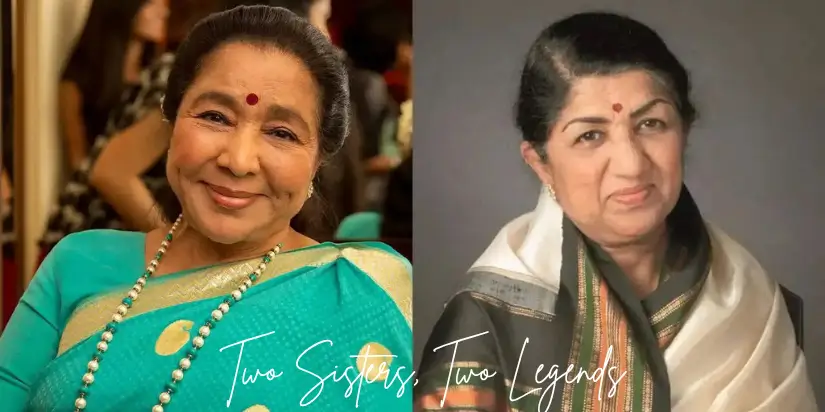
The “fight” between the two sisters, Lata Mangeshkar and Asha Bhosle, is a famous story in India. It was a mix of family drama and a race to be the best singer in Bollywood.
- The Family Split: It all started when Asha was only 16. She ran away to marry a man much older than her. This made Lata very angry, and the sisters did not speak for many years.
- Finding Her Own Voice: At first, composers gave all the “good” and “pure” songs to Lata. Asha was given the “fast” or “dance” songs that Lata didn’t want. Asha tried to sound like her sister for a while, but she soon realized she had to be different to be famous. She created her own “cool” and “modern” style.
- Coming Back Together: After Asha left her first husband, she moved back near her family. The sisters lived in side-by-side flats in Mumbai for most of their lives. They shared food and talked every night.
- The Perfect Ending: Even though people thought they were rivals, they were very close at the end. In an amazing coincidence, both sisters died at the same age (92) and on the same day of the week (Sunday).
Lata was the “soul” of Indian music, and Asha was the “energy.” Together, they gave us the best songs in history.
The Bottom Line: A Voice That Will Never Grow Old
Asha Bhosle’s life wasn’t just a collection of songs; it was a masterclass in resilience. She taught us that you can be “second” and still become “second to none.” From a young girl fetching water from a well to a global icon with a Guinness World Record, she proved that even the toughest storms can be turned into a beautiful melody.
Rest in Melody, Asha Tai. You didn’t just sing for an era; you sang for eternity.
Dazzlerr is a platform where you get entertainment news, casting calls, trending fashion, and much more.
Similar Posts