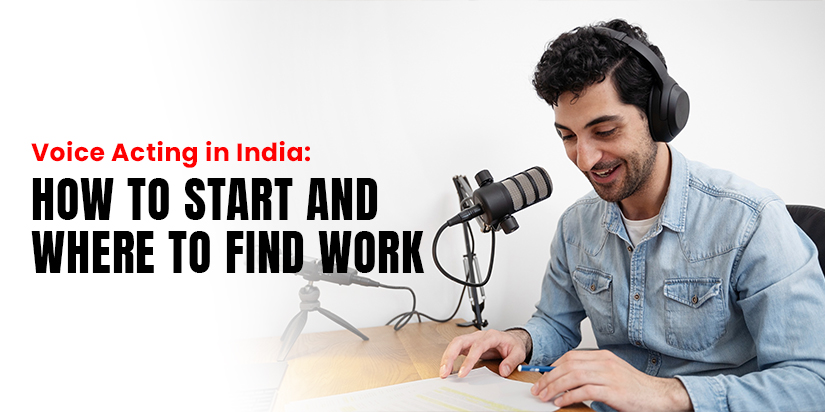
What if your voice could sell a product, bring an animated character to life, narrate an audiobook, or become the Hindi voice of an international star—without ever appearing on camera?
You do not need to be on screen to build a career in entertainment. In India, voice artists work across OTT content, animation, advertising, e-learning, gaming, audiobooks, podcasts, corporate videos, and digital campaigns.
Regional languages have also expanded opportunities beyond Hindi and English. However, a naturally good voice is not enough. Professional voice work requires acting skills, clear pronunciation, voice control, script interpretation, and the ability to take direction.
You can start small by practising at home, creating a focused demo, building a basic recording setup, and applying for legitimate voice over jobs. Treat your voice as a professional skill rather than a hobby.
Table of Contents
- What Does a Voice Actor Actually Do?
- What Skills Do You Need to Become a Voice Actor?
- How to Start Voice Acting in India
- Where Can You Find Voice Acting Work in India?
- How Much Can a Voice Actor Earn in India?
- What Affects Voice Acting Fees?
- Common Mistakes Beginners Should Avoid
- How to Get Your First Voice Acting Project
- Can You Become a Voice Actor Without Formal Training?
- Final Takeaway: Build Your Voice, Then Build Your Career
- FAQs
What Does a Voice Actor Actually Do?
A voice actor performs through sound, unlike an on-screen actor, a voice artist cannot depend on facial expressions, costumes, or body language. Emotion has to come through the voice itself.
A professional may change pitch, pace, volume, pauses, pronunciation, and tone to match a character or script.
For example, an advertisement may need confidence and energy. An audiobook may require a calm storytelling style. A children’s animation may demand several distinct characters. A corporate training video may need a clear and reassuring delivery. This is why voice acting in India is not simply about reading words aloud.
What Skills Do You Need to Become a Voice Actor?
To build a successful voice-acting career, you need more than a pleasant voice. The following skills can help you deliver scripts effectively, adapt to different roles, and meet professional recording requirements.
1. Acting and Emotional Expression
Voice acting begins with acting. A script may say, “I cannot believe you did this,” but the delivery can completely change its meaning. It could sound angry, shocked, amused, disappointed, or playful.
You need to understand the situation behind the words. Then you need to communicate that situation through your voice.
2. Voice Control and Modulation
Voice modulation helps you control how the audience experiences your performance. You should practise:
- Pitch.
- Pace.
- Volume.
- Tone.
- Pauses.
- Emphasis.
- Breathing.
- Articulation.
Do not force a deeper or more dramatic voice simply because it sounds impressive. A natural and controlled delivery is usually more useful.
3. Language and Pronunciation
India’s multilingual market can work in your favour. If you are genuinely fluent in more than one language, mention it clearly in your profile.
Native-level pronunciation can be particularly useful for regional campaigns, dubbing, advertisements, e-learning, and localisation.
4. Script Reading
Good voice artists do not sound like they are reading. They understand the sentence before delivering it.
Practise reading the same line in different ways. Change the emotion, pace, and emphasis while keeping the pronunciation clear.
5. Listening and Taking Direction
Professional recording sessions can involve several revisions. A director may ask you to sound warmer, slower, more conversational, more energetic, or less dramatic.
You need to make the change quickly. This ability can be just as valuable as your natural vocal quality.
How to Start Voice Acting in India
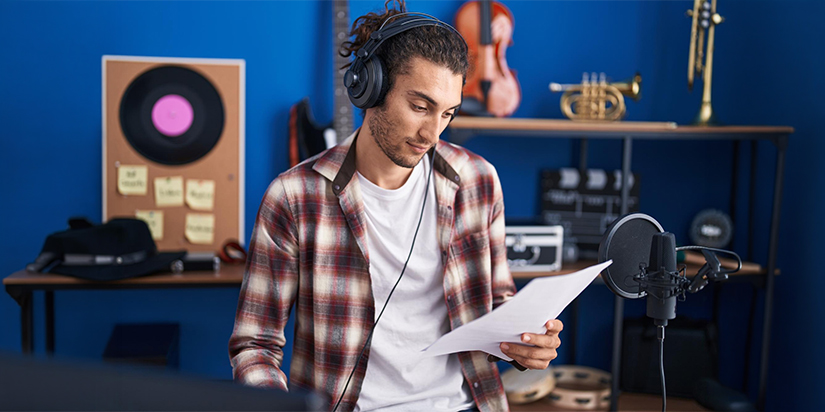
Image source: Magnific
Step 1: Choose Your Voice Acting Niche
Do not try to create one demo that proves you can do everything. Start by identifying the type of work you want.
You could focus on:
- Commercial voice-over
- Film or OTT dubbing.
- Animation.
- Audiobooks.
- E-learning.
- Gaming.
- Corporate narration.
- Character voices.
Your choice will influence the type of practice, demo, and clients you pursue. For example, an animation demo should show character range. A commercial demo should demonstrate clarity, energy, and brand-friendly delivery.
Step 2: Practise Before Buying Expensive Equipment
You do not need a professional studio on your first day. Start by recording yourself on a basic device in a quiet room.
Read advertisements, short stories, news-style scripts, and conversational dialogue. Listen to the recording afterwards.
Look for:
- Unclear words.
- Uneven pace.
- Excessive pauses.
- Breath noise.
- Flat delivery.
- Forced expressions.
Then record the same script again. This simple process can teach you a lot about your voice.
Step 3: Build a Professional Voice Demo
A demo is your audio portfolio. It gives casting professionals and clients a quick idea of what you can do.
Create samples that match your target niche. If you want commercial work, include commercial-style reads. If you want character work, demonstrate different characters.
Keep the presentation clean. Your voice should be easy to hear. Background music should never overpower your performance.
You can create separate demos as your skills develop. This is often more useful than one long recording containing unrelated styles.
Step 4: Set Up a Basic Home Recording Space
Once you begin pursuing paid work, recording quality becomes important. Your first priority should be the room. A quiet space with limited echo can make a noticeable difference. Curtains, carpets, soft furnishings, and other sound-absorbing materials can help reduce unwanted reflections.
Then consider:
- A suitable microphone.
- Closed-back headphones.
- A pop filter.
- A microphone stand.
- Recording software.
- Basic audio-editing knowledge.
Do not assume that the most expensive microphone will automatically produce professional audio. A poor recording environment can undermine expensive equipment.
Step 5: Create a Professional Portfolio
Your profile should answer basic questions quickly.
Mention:
- Your name.
- Languages.
- Accents or dialects you can genuinely perform.
- Voice styles.
- Areas of specialisation.
- Demo links.
- Relevant experience.
- Contact details.
Keep the information updated. If you have completed a legitimate project, ask the client whether you can use the work as a sample before adding it to your portfolio.
Where Can You Find Voice Acting Work in India?

Image source: Magnific
Finding your first project can feel harder than developing your voice. That is normal. The industry is spread across agencies, studios, production houses, freelance marketplaces, casting networks, advertising companies, and direct client relationships.
1. Voice Acting Agencies and Casting Companies
Agencies can connect artists with advertising, dubbing, corporate, and entertainment projects. Before working with an agency, research its track record. Look for a professional website, identifiable projects, clear communication, and transparent terms.
Be cautious if someone promises guaranteed paid work in exchange for an upfront registration or audition fee.
2. Freelance Platforms
Online freelance platforms can help beginners find smaller projects. These may include narration, advertisements, e-learning, YouTube videos, IVR recordings, and other short-form assignments.
Do not apply randomly. Read the brief first. Check the required language, accent, recording quality, deadline, payment terms, revision requirements, and usage rights. This will help you apply for voice over jobs that actually match your skills.
3. Production Houses and Studios
Research legitimate dubbing studios, animation companies, audio production houses, advertising agencies, and production companies. If a studio accepts artist submissions, send a short and relevant introduction with your demo. Do not send a huge collection of unrelated audio files.
One strong demo is usually more useful than ten average ones.
4. Social Media and Professional Networking
Social platforms can also help you become visible. Instagram can showcase short voice samples. LinkedIn can help you connect with production professionals, agencies, advertising teams, and content companies.
You can also follow casting directors and production studios to understand the kind of projects entering the market. Networking should be professional.
Avoid repeatedly sending unsolicited messages asking only, “Do you have work?” Instead, introduce yourself briefly and share a relevant demo when appropriate.
How Much Can a Voice Actor Earn in India?
There is no single standard salary for voice actors in India. Most professionals are paid per project, session, finished minute, finished hour, or according to usage rights. Fees vary based on experience, language, performance requirements, turnaround time, and distribution platform.
| Source or Rate Type | Project or Service | Indicative Rate | Basis or Conditions | Important Note |
|---|---|---|---|---|
| Prasar Bharati official rate card, 2023 | “Others” category, national level | ₹5,000 | Per programme | Official Prasar Bharati rate; not a universal commercial market rate |
| Prasar Bharati official rate card, 2023 | “Others” category, regional level | ₹3,000 | Per programme | Official Prasar Bharati rate; higher categories have higher rates |
| Susheel C’s 2026 rate guide | Local digital commercial | ₹10,000–₹15,000 | One-year, single-platform usage; experienced professional | Individual market guidance, not an official industry-wide tariff |
| 2026 Indian contracted-booking benchmark | Advertising voice-over spot, entry level | ₹8,000 | Per spot | Indicative benchmark based on contracted bookings |
| 2026 Indian contracted-booking benchmark | Advertising voice-over spot, mid level | ₹18,000 | Per spot | Indicative benchmark based on contracted bookings |
| 2026 Indian contracted-booking benchmark | Advertising voice-over spot, established artist | ₹45,000 | Per spot | Indicative benchmark based on contracted bookings |
| 2026 Indian contracted-booking benchmark | Audiobook narration | ₹2,200–₹8,000 | Per finished hour; varies by experience | Indicative benchmark based on contracted bookings |
Sources
1. Prasar Bharati, “Rate Card for Artist and Casual Assignees,” 2023
Official rate card listing voice-over, narration, dubbing, and other artist fees for national and regional programming:
https://prasarbharati.gov.in/wp-content/uploads/guidelines/DD-Letter-dt-04-07-2023-Rate-Card-for-Artist-and-Casual-Assignees-1.pdf
2. Susheel C, “Voice Over Cost in India,” 2026
An individual professional rate guide covering commercial voice-over pricing, usage, and project factors:
https://www.indianvoiceartist.com/2026/voice-over-cost-india/
3. Suyaara, “Voice-Over Rates,” 2026
An India-focused rate benchmark based on contracted bookings, including advertising voice-over and audiobook narration:
https://www.suyaara.com/rates
These figures should be treated as benchmarks, not promises. Before accepting a project, clarify whether the quoted amount includes usage rights, revisions, studio costs, taxes, and additional versions.
What Affects Voice Acting Fees?
Two projects with the same script length can have very different fees. Several factors matter.
1. Project Type
A short social media advertisement and a national television commercial do not have the same commercial value.
2. Usage Rights
Ask where the recording will be used. Is it for an internal presentation? YouTube? Instagram? Television? OTT? Radio? Broader usage can affect the fee.
3. Recording Duration
Some clients pay by session. Others use finished minutes, finished hours, words, prompts, or project rates. Understand the pricing model before recording.
4. Language and Performance Requirements
A specialised regional-language performance, character role, or difficult accent may require different preparation from a straightforward narration.
5. Experience
As your demo, credits, skills, and client base improve, you can negotiate more confidently. That does not mean beginners should underprice themselves indefinitely.
Common Mistakes Beginners Should Avoid
1. Using the Same Demo for Every Project
A gaming client and an e-learning company may need completely different performances. Match your demo to the brief.
2. Thinking a “Good Voice” Is Enough
A pleasant voice cannot replace acting. Professional voice work requires interpretation, control, timing, and consistency.
3. Buying Expensive Equipment Too Early
First improve your technique and recording environment. Upgrade equipment as your work requires it.
4. Ignoring Regional Languages
If you can genuinely speak a regional language naturally, make it visible in your portfolio. Do not claim fluency in a language simply because you can read its script.
5. Accepting Unclear Payment Terms
Before starting, confirm the fee, deadline, revisions, usage, and payment schedule. Written confirmation is better than relying on a verbal promise.
6. Paying for Guaranteed Work
Be particularly careful with anyone who says you will definitely receive paid voice over jobs after paying a registration, audition, or membership fee.
A legitimate service may charge for training or another clearly defined service. That is different from guaranteeing employment.
How to Get Your First Voice Acting Project
Your first project may not be a film or major advertisement. That is fine. Start with legitimate opportunities that match your current ability.
You might begin with a short e-learning narration, corporate video, regional advertisement, audiobook sample, YouTube narration, or small dubbing assignment.
Each project teaches you something. You learn how clients communicate. You become faster at interpreting scripts. You understand recording requirements. You also start building professional references.
At the same time, keep practising. Update your demos when your skills improve. Add strong work to your portfolio after receiving the necessary permission. Keep a record of clients and projects.
Most importantly, continue applying. The first few voice over jobs may take time to secure. Consistency matters because voice acting is both a creative skill and a professional business.
Can You Become a Voice Actor Without Formal Training?
Yes! A formal acting or voice course can help, but it is not the only route into the profession.
Many beginners start with self-practice. They read scripts, record themselves, study professional performances, and gradually improve their technique.
Training can become useful when you need structured feedback. A good coach can help you work on breathing, diction, modulation, characterisation, microphone technique, and script interpretation.
The important point is to practise with purpose. Do not spend months simply changing your voice. Learn how to make the voice serve the character, story, product, or audience. That is at the heart of voice acting in India as a professional skill.
Final Takeaway: Build Your Voice, Then Build Your Career
Voice acting can be a rewarding career in India, but it takes practice, patience, and professionalism. Build your skills, create a strong demo, and look for genuine voice over jobs through trusted platforms and industry networks.
Keep practising, keep improving, and let your voice open the door to your next opportunity.
If you are looking to build your presence in the entertainment industry, Dazzlerr can help you connect with opportunities and showcase your talent to the right audience.
FAQs
1. How can I start voice acting in India?
Start by practising voice modulation, improving pronunciation, choosing a niche, creating a demo reel, and applying for legitimate casting and voice-over opportunities.
2. Do I need formal training to become a voice actor?
No. Formal training can help, but consistent practice, acting skills, a strong demo, and practical recording experience can also help you enter the industry.
3. What qualifications are needed for voice acting?
There is no specific educational qualification required. Strong language skills, clear pronunciation, acting ability, voice control, and professional discipline are more important.
4. Where can I find voice over jobs in India?
You can find opportunities through casting agencies, production houses, dubbing studios, freelance platforms, advertising agencies, and professional networking channels.
5. How much does a voice actor earn in India?
Earnings vary by project, experience, language, usage rights, and client. Voice artists may be paid per session, project, finished minute, or finished hour.
6. Is voice acting a good career for beginners in India?
Yes. Beginners can start with smaller projects such as e-learning, corporate narration, digital advertisements, YouTube content, and audiobook work before moving to larger assignments.
7. Which languages are useful for voice acting in India?
Hindi and English are widely used, while regional languages such as Tamil, Telugu, Bengali, Marathi, Kannada, Malayalam, Gujarati, and Punjabi can offer additional opportunities.
8. What equipment do I need to start voice acting from home?
A suitable microphone, headphones, pop filter, recording software, and a quiet room with limited echo are enough to create a basic home recording setup.
9. How do I create a voice acting demo?
Choose samples that match your target niche. Keep the demo short, clear, and varied, and make sure your voice remains easy to hear without excessive background music.
10. How can I identify fake voice acting opportunities?
Be cautious about guaranteed jobs, unclear clients, pressure to pay upfront fees, and vague project details. Always verify the company and clarify payment and usage terms before recording.
Similar Posts